Fire dampers are one of the most important fire safety devices in any commercial building, yet they remain one of the most overlooked. Hidden inside ductwork, tucked above suspended ceilings, and frequently absent from building asset registers, fire dampers can go untested for years without anyone realising.
This guide brings together everything a duty holder, facilities manager, or responsible person needs to know about fire damper testing and inspection in the UK. It covers what fire dampers are and how they work, the legal framework governing their maintenance, how often testing should take place, what a compliant inspection involves, common causes of failure, and who is responsible for managing the process.
At Swift Fire Compliance, we have drawn on years of hands-on fire damper testing experience across commercial, healthcare, education, and high-security sites to put this guide together.
What Are Fire Dampers and How Do They Work?
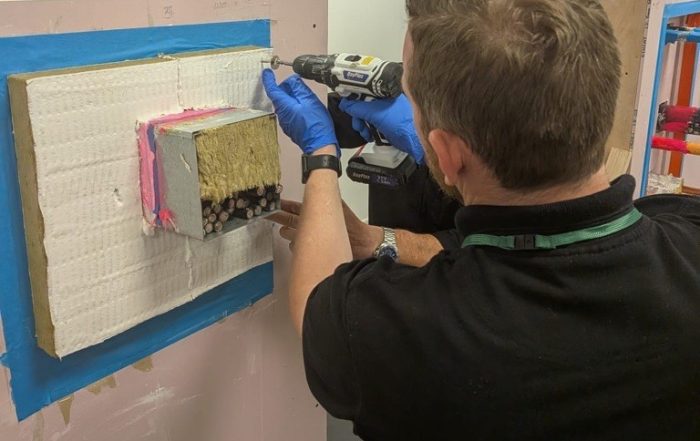
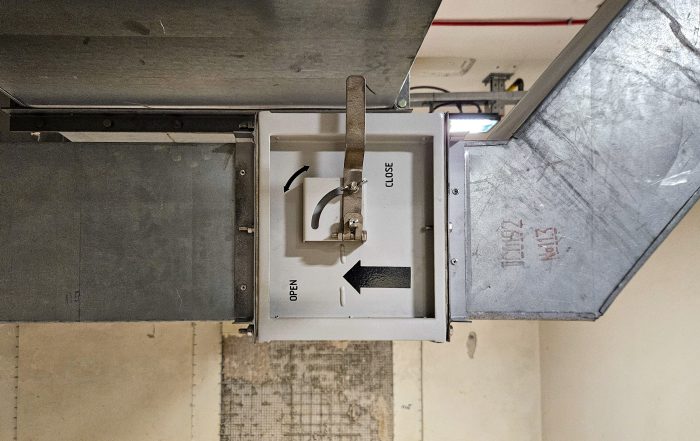
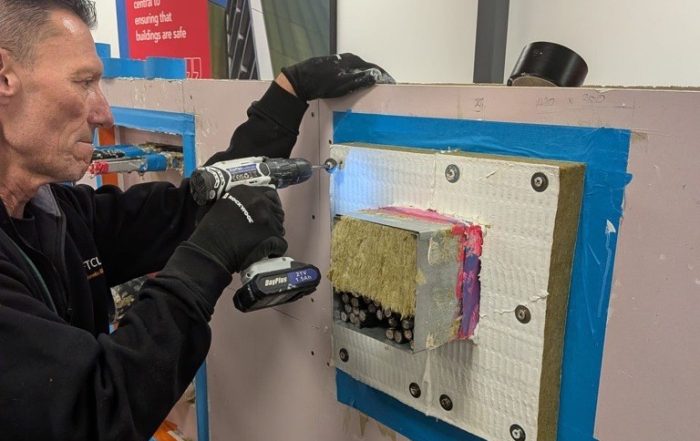
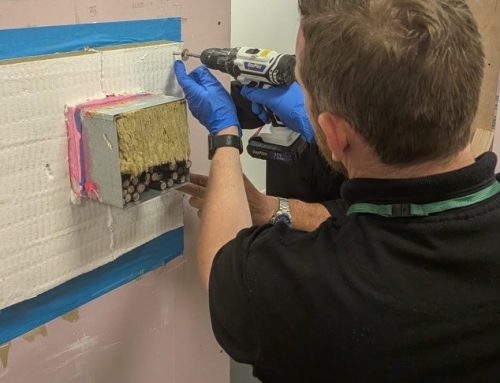
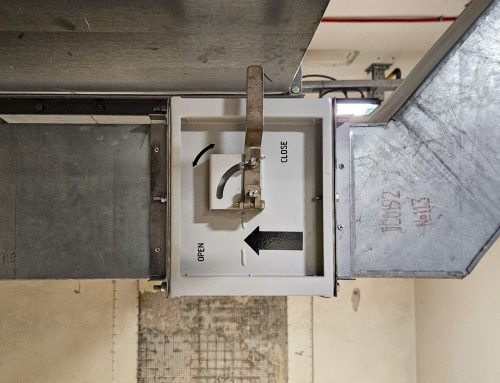
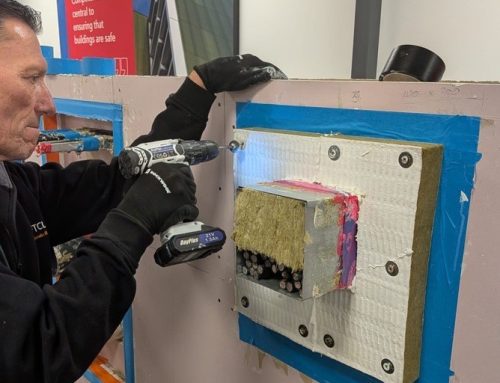
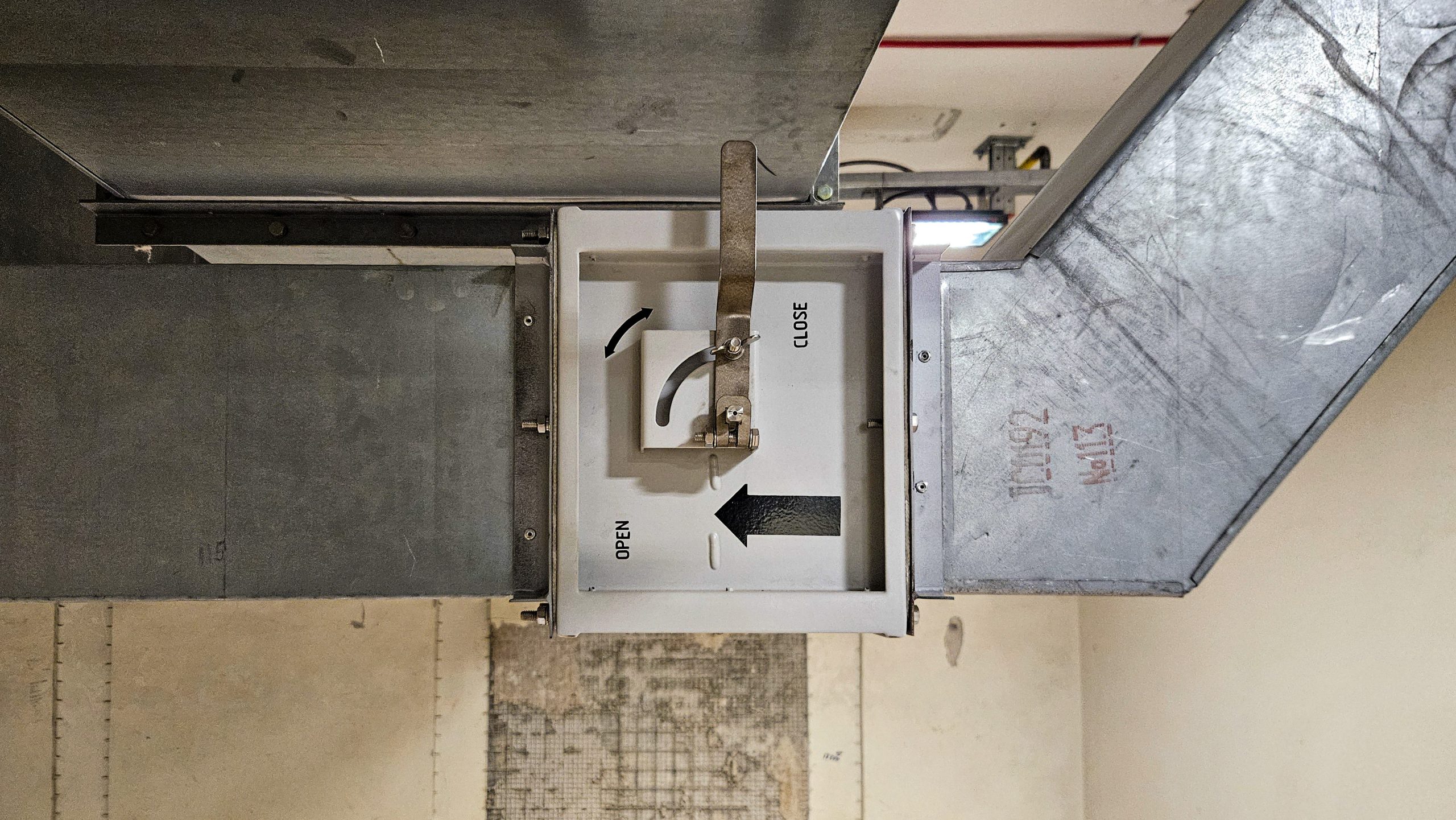
A fire damper is a passive fire protection device installed within ductwork at the point where it passes through a fire-resisting wall, floor, or partition. Their purpose is to slow the spread of fire and smoke through a building’s ventilation system from one fire compartment to another.
| For a more detailed explanation of how fire dampers work, the different types available and their role in passive fire protection, read our guide: Fire Dampers Explained. |
Most fire dampers operate through a fusible link, a small component made from a material that melts at a specific temperature, typically around 72°C. When a fire causes the surrounding air temperature to rise to this threshold, the fusible link melts, releasing a spring mechanism that snaps the damper blades shut. This is a purely mechanical process that requires no electricity and no manual intervention, which makes it highly reliable even during a power failure.
Some dampers are electrically operated instead, closing automatically when triggered by a signal from the building’s fire alarm or smoke detection system. These are more often described as smoke control dampers, and combined fire and smoke dampers that respond to both heat and electronic signals are increasingly common in modern buildings.
Without a functioning fire damper at every penetration point, ductwork becomes a direct route for fire and smoke to spread rapidly through a building, compromising escape routes and giving occupants far less time to evacuate safely.
| For a deeper explanation of the mechanics involved, read our article on how fire and smoke dampers work. |
Is Fire Damper Testing a Legal Requirement?
Yes. Fire damper testing is a legal requirement for almost every commercial building in the UK. Under the Regulatory Reform (Fire Safety) Order 2005, the Responsible Person has a legal duty to ensure that fire safety systems within a building are maintained in an efficient state, in efficient working order, and in good repair.
BS 9999:2017, the British Standard code of practice for fire safety in the design, management, and use of buildings, sets out the recognised testing standard that HSE officers and fire prevention inspectors use to assess compliance. It states that fire dampers should be function tested at least annually under normal conditions, with more frequent testing required in certain environments.
Failure to maintain a compliant fire damper testing programme carries serious consequences:
- Building insurance may be invalidated if non-compliant dampers are found to have contributed to the spread of a fire
- Enforcement action can be taken by the HSE or local fire authority
- In the most serious cases involving injury or death, prosecutions for corporate manslaughter are possible
| For a complete breakdown of the legal position, read our detailed guide on why fire damper testing is a legal requirement. |
Key takeaway: Fire damper testing is not optional guidance. It is a legal obligation under the Regulatory Reform (Fire Safety) Order 2005, assessed against the BS 9999:2017 standard.
Who Is Responsible for Fire Damper Testing?
Under the Regulatory Reform (Fire Safety) Order 2005, the Responsible Person bears legal accountability for ensuring fire safety systems, including fire dampers, are properly maintained. In a single-occupancy workplace, this is typically the employer. In multi-occupied buildings, the Responsible Person may be the building owner, landlord, or managing agent.
This responsibility cannot be transferred simply by appointing a contractor. The Responsible Person must ensure that any contractor engaged is competent, that the work is carried out to the required standard, and that documentation is retained as evidence of compliance. Appointing a specialist testing company manages the practical delivery of the work, but legal accountability always remains with the Responsible Person.
This distinction matters enormously in the event of an audit, insurance claim, or fire investigation. Without detailed, dated records of every test and its outcome, compliance cannot be demonstrated, regardless of whether the underlying work was actually carried out.
| For a full explanation of who holds this responsibility and what it requires, read our guide on who is responsible for fire damper testing in the UK. |
How Often Should Fire Dampers Be Tested?
Annual testing is the minimum requirement under BS 9999:2017 for most buildings, but the appropriate frequency depends on the environment and how the building is used.
| Building or Environment Type | Recommended Testing Frequency |
|---|---|
| General commercial buildings | Annually, as a minimum |
| Healthcare settings | More frequent testing, per HTM guidance |
| Dust or pollutant-heavy environments | Increased frequency, based on contamination risk |
| New installations | Tested prior to building occupation |
| Spring-operated dampers | Specific intervals per manufacturer guidance |
Testing frequency should always be confirmed through a site-specific risk assessment carried out by a qualified engineer.
| For the full breakdown of testing intervals and the reasoning behind them, read our guide on how often fire and smoke dampers should be tested, and our piece on why annual testing is more than just a compliance tick box. |
What Happens During a Fire Damper Inspection?
Understanding what a thorough fire damper inspection involves helps building managers ask the right questions and evaluate the quality of the service they receive. A compliant inspection programme should include the following stages:
Asset register creation or update. Before testing can begin, every damper in the building needs to be located and logged against a unique reference. Many buildings have incomplete or entirely missing records, so this step is often the first and most valuable part of the process.
Access verification. Each damper is checked to confirm it can be safely and properly accessed. Where access panels do not exist, this is recorded as a non-compliance requiring remedial action.
Function or drop testing. Each damper is triggered to confirm it closes fully and correctly, then reset to its open operational position. This is the core test that provides documented evidence of operational status.
Visual inspection. Engineers check for corrosion, physical damage, obstructions, and signs of incorrect or non-compliant installation.
Cleaning of channels and runners. Dust, debris, and corrosion can prevent a damper from closing fully even if the mechanism is otherwise functional. Cleaning is a standard part of any thorough inspection, not an optional extra.
Photographic evidence. Dampers should be photographed in both open and closed positions, along with their location and any defects identified.
Compliance reporting. A detailed report is produced for every damper, recording its location, access status, test result, inspection notes, and any required remedial actions. This documentation forms the audit trail a Responsible Person needs in the event of an inspection or claim.
| For a full walkthrough, read our guide on what happens during a fire damper inspection, and our guide on how to identify fire dampers if you are unsure whether your building has them or where they are located. |
Not Sure What a Compliant Report Should Look Like?
Download our free checklist to find out whether your current fire damper reports meet the required standard. No forms, no sign-up required.
Download the Free ChecklistWhy Do Fire Dampers Fail?
Even a well-installed fire damper can fail if it is not properly maintained. The most common causes of failure include:
- Dust, debris, or grease build-up preventing the blades from closing fully
- Corrosion affecting the damper frame, blades, or fusible link
- Mechanical damage caused by impact, vibration, or age
- Incorrect or non-compliant original installation
- Broken or seized springs in spring-operated mechanisms
- Obstructions such as cabling, insulation, or building materials lodged within the damper housing
A single failed damper can have serious consequences in a fire, allowing smoke and flames to spread through a compartment that was assumed to be protected. This is precisely why annual testing exists: it identifies these failures before they matter, rather than after.
| Read our detailed guide on why fire dampers fail and our practical advice on common fire damper failures and how to prevent them. |
What Happens If a Fire Damper Fails Its Test?
If a damper fails its function test, it must be repaired or replaced as soon as reasonably practicable. Leaving a known, documented failure unaddressed is not a defensible position under the Regulatory Reform (Fire Safety) Order 2005, and represents an active gap in the building’s fire compartmentation.
Remedial works typically fall into a small number of categories: repairing a damper that has failed due to debris, corrosion, or a damaged mechanism; replacing a damper that is beyond economical repair; installing an access panel where none currently exists; or rectifying a fire compartment breach where the surrounding construction has been compromised. Once remedial work is complete, the damper should be re-tested and the updated compliance status documented.
| To understand more about the cost implications of delaying this work, read our article on why cutting corners on fire and smoke control damper testing could cost you more than money. |
Should You Use a Professional Fire Damper Testing Company?
While there is no single licensing body that exclusively governs fire damper testing competence in the way some other trades are regulated, BESA members use the SKEB approach to demonstrate compliance. SKEB stands for Skills, Knowledge, Experience, Behaviours. The free BESA SKEB toolkit can be downloaded here.
Using a competent, accredited specialist matters for several reasons. Testing engineers need to understand building construction sufficiently to identify compartment lines and correctly locate dampers, they need specialist tools to safely access and test dampers without causing damage, and they need to produce documentation that will genuinely stand up to scrutiny from insurers, fire authorities, or in the event of a legal inquiry.
A poorly conducted test that misses dampers, fails to record access issues accurately, or produces vague, unverifiable reports can leave a Responsible Person in a worse legal position than having no records at all, since it creates a false impression of compliance.
| Read our article on whether you need professionals for fire and smoke damper testing for more details on what to look for in a competent contractor. |
Keeping Fire Dampers Fit for Purpose Over the Long Term
Testing is only one part of a wider fire damper management strategy. Building managers who treat fire damper compliance as an ongoing programme, rather than an annual event, are far better placed to avoid failures, manage budgets, and demonstrate due diligence.
This means maintaining an accurate and continuously updated asset register, scheduling remedial works promptly when failures are identified, retaining full documentation in an accessible format, and reviewing testing frequency periodically as building use or occupancy changes.
| For more on building this into a long-term strategy, read our article on keeping fire dampers fit for purpose. |
Want the Full Picture on Fire and Smoke Control Dampers?
Download our Ultimate Guide to Fire & Smoke Control Dampers for a complete reference you can keep and share with your team.
Download the Ultimate GuideWhy Choose Swift Fire Compliance?
Swift Fire Compliance is a specialist division of Swiftclean, a BESA-accredited contractor with over 40 years of experience delivering building compliance services across the UK. All of our fire damper testing, inspection, installation, and remedial works are carried out in line with BS 9999:2017 and the Regulatory Reform (Fire Safety) Order 2005, by our own directly employed engineers. We do not use subcontractors, which means every site receives the same standard of work regardless of building type or complexity.
Following every inspection, we produce a full compliance report including damper locations, test results, photographic evidence, and any remedial recommendations, made available through our online client portal for immediate access by your team, your insurers, or your fire authority.
We work across a wide range of sectors, including commercial offices, healthcare, social housing, education, hospitality, and high-security sites, bringing the same level of technical rigour to every environment we work in.
Read Our Fire Damper Case Studies
Discover how Swift Fire Compliance has helped organisations across the UK achieve fire damper compliance through professional inspections, testing, remedial works and detailed reporting. Explore real-world projects and see how our expertise has helped keep commercial buildings safe and compliant.
View Our Case StudiesIs Your Fire Damper Testing Programme Compliant?
If you do not currently have a documented, up-to-date fire damper testing programme in place, now is the time to put one in place. The legal obligations are clear, the consequences of non-compliance are serious, and getting compliant is straightforward when you work with the right specialist.
Frequently Asked Questions About Fire Damper Testing
How long does a fire damper test take?
The time required depends on the number of dampers in the building and how accessible they are. A single damper test typically takes a matter of minutes once access is established, but locating dampers, installing access panels where needed, and producing full documentation means a building with hundreds of dampers can require several days of engineer time. A specialist contractor can provide a time estimate once the scope of the building has been assessed.
Can fire damper testing be carried out without disrupting my building?
In most cases, yes. Experienced engineers are used to working around occupied buildings, scheduling access to plant rooms, ceiling voids, and service risers with minimal disruption to staff, residents, or visitors. For sensitive environments such as healthcare or education settings, testing can often be scheduled outside of normal operating hours.
What qualifications should a fire damper testing engineer have?
There is no single mandatory qualification for fire damper testing in the UK, but engineers should be trained and competent in BS 9999:2017 testing methodology, and ideally be a member of the BESA – Building Engineering Services Association.
Do all buildings have fire dampers?
Not necessarily. Fire dampers are only required where ductwork passes through a fire-resisting wall, floor, or partition. Smaller buildings without ducted ventilation systems, or those using natural ventilation only, may not have any fire dampers installed. A site survey is the only reliable way to confirm whether your building has fire dampers and where they are located.
What is the difference between a fire damper survey and a fire damper test?
A fire damper survey is the process of locating and recording every damper within a building, typically used to create or update an asset register where records are missing or incomplete. A fire damper test, or function test, is the process of activating each damper to confirm it closes correctly. A survey is often the necessary first step before a comprehensive testing programme can be carried out.
About the Author: Richard Crews